Saturday, February 26, 2011

The Thirteen Curses - Michelle Harrison


Title: The Thirteen Curses (Book 2 in The Thirteen Treasures series)
Author: Michelle Harrison
Publisher: Simon and Schuster UK, 2010 (Paperback)
Length: 452 pages
Genre: Young Adult/Children's Fantasy
Started: February 21, 2011
Finished: February 26, 2011

Summary:
From the back of the book:
When fairies stole her brother, Red vowed to get him back. Now trapped in the fairy realm, she begs an audience with the fairy court where she strikes a bargain. Her brother will be returned - but only if she can find the charms of Tanya's bracelet, scattered in the human world.

Returning to Elvesden Manor, Red is assisted by Tanya and Fabian, and a desperate hunt begins. Soon they make a shocking discovery. The charms are now cursed with the twisted qualities of the thirteen treasures they represent...and the longer they are missing, the worse the consequences will be. Can Red, Tanya, and Fabian find all the charms? And even if they do, will the fairies keep their promise?

Review:
If you haven't read the first book in the series, The Thirteen Treasures, then you might want to skip to the Recommendations part of the review, since I can't talk about this second book without spoiling the first one. If you've got no qualms about spoilers, then by all means read along.

Sequel to The Thirteen Treasures, The Thirteen Curses takes place a few months after the events of the previous book. Red is stuck in the fairy realm while Tanya and Fabian are back at Elvesden Manor trying to figure out why Warwick and their new housekeeper Nell are missing. This sequel doesn't suffer from the slow-to-start issues that The Thirteen Treasures did, the action picks up here and doesn't let go. It also helps that the reader's following three separate plot threads in the first half of the book, so there's always something interesting you're following: Red in the fairy realm trying to get an audience with the Seelie Court, Red's flashbacks of what led up to her brother James' disappearance, and Tanya and Fabian back at Elvesden. Once you get to the mid-point of the novel, you get to the plot that's actually summarized on the back of the book: the three kids hunting down the charms from Tanya's bracelet before chaos erupts so they can get James and Warwick back.

Not only is the pacing not an issue in this book (my only complaint from the first book), but Red gets some remarkable character development here, and I love how Red's not always a nice person, it's refreshing to see a child protagonist in a children's book that's actually cruel to a certain extent, it's not something you see too often.

Recommendation:
I liked The Thirteen Curses even more than the first book, this series keeps getting better and better. This is definitely one of the best series I've read in a while, so read these! Remember, the second and third books in this series (The Thirteen Curses and The Thirteen Secrets) aren't available domestically yet, only in the UK, so you'll have to order them via The Book Depository if you want to get your hands on them, but it's so worth the effort.

Thoughts on the cover:
Whereas the first book's cover was a solid red, this one is a mix of purple and teal. I love the illustration and how it incorporates the title, it's rare to see a children's book cover that relies on objects rather than people to attract your attention, and these covers pull it off remarkably well.

Friday, February 25, 2011

The Little White Horse - Elizabeth Goudge


Title: The Little White Horse
Author: Elizabeth Goudge
Publisher: Lion Hudson, 2008 (Paperback) (Originally published 1946)
Length: 222 pages
Genre: Children's Classic
Started: February 22, 2011
Finished: February 25, 2011

Summary:
From Goodreads.com:
In 1842, newly orphaned Maria Merryweather, her governess, and dog arrive at her ancestral home in an enchanted village in England's West Country where the people's bliss is marred by a dark shadow.

Review:
I'll admit, the only reason I even picked up this book was because I came across the recent movie version, The Secret of Moonacre, and wanted to read the original source. I liked the premise of the movie but thought it was poorly executed and the plot was confusing at times. So I picked up the original book, The Little White Horse, which is a strange title since the horse doesn't show up all too often. This reads like a classic children's book like the Narnia series: the writing style is very reminiscent of the 40s and 50s, the descriptions are very detailed and vibrant, and it hasn't held up well over time.

Maria Merryweather is orphaned when her father dies and goes to live with her second cousin Sir Benjamin at their family's ancestral home, Moonacre Manor. She must uncover her family's past and remedy the wrongs made by all the adults involved and restore the village and valley to its former glory. In a manner befitting children's books of the period, the heroine glides through the book's plot because things happen to her, not because she seeks out anything on her own. She's saccharine sweet and loving and adults mysteriously give in to her whims because she asks politely. There's the whole religious aspect where the bad guys are atheists and they magically convert and mourn the error of their ways, and the sexism, oh the sexism.

But if you've ever read older children's books from 50-60 years ago you're familiar with all of this. They don't exactly transition well to the modern day, but this one isn't so bad since the plot takes place in Victorian England so we can always say "it's historical, the men are allowed to be sexist." Putting all that aside, I loved this book. I have a special place in my literary heart for British children's books like The Secret Garden and A Little Princess that I read as a child and adored, and I would have had the same reaction to The Little White Horse if I'd read it when I was 10. I can appreciate beautiful writing style of these older books and how wonderfully simplistic and charming they are. They remind me of carefree childhoods where young children randomly went out and frolicked in the woods till after dark and no one called the police to report them missing. You have to admit, these books are good for nostalgia. The Little White Horse is charming and magical (though much less fantasy-like than the movie makes it out to be), and another great children's classic...but I'm pretty sure boys wouldn't touch this book, Maria's too interested in clothes and flowers and being a girl to engage male readers. For young girls that love the old classics though, this is a wonderful choice that will be surely enjoyed.

Recommendation:
If there's a young girl in your life that's reading the old classics like The Lion, The Witch, and the Wardrobe; The Secret Garden, A Little Princess, etc., then pick up The Little White Horse for her, she'll love it. It goes without saying that the movie version of this novel is very different so make sure you read the book in addition to seeing the film so you get the whole story.

Thoughts on the cover:
This is the movie tie-in cover, so it reflects the extra fantasy elements from the movie. The regular covers usually have the 'little white horse' itself on it with a castle/mansion in the background with a nice dash of purple.

Sunday, February 20, 2011

Moon Over Manifest - Clare Vanderpool


Title: Moon Over Manifest
Author: Clare Vanderpool
Publisher: Delacorte Press, 2010 (Hardcover)
Length: 342 pages
Genre: Children's Historical Fiction
Started: February 17, 2011
Finished: February 20, 2011

Summary:
From the inside cover:
Abilene Tucker feels abandoned. Her father has put her on a train, sending her off to live with an old friend for the summer while he works a railroad job. Armed only with a few possessions and her list of universals, Abilene jumps off the train in Manifest, Kansas, aiming to learn about the boy her father once was.
Having heard stories about Manifest, Abilene is disappointed to find that it’s just a dried-up, worn-out old town. But her disappointment quickly turns to excitement when she discovers a hidden cigar box full of mementos, including some old letters that mention a spy known as the Rattler. These mysterious letters send Abilene and her new friends, Lettie and Ruthanne, on an honest-to-goodness spy hunt, even though they are warned to “Leave Well Enough Alone.”
Abilene throws all caution aside when she heads down the mysterious Path to Perdition to pay a debt to the reclusive Miss Sadie, a diviner who only tells stories from the past. It seems that Manifest’s history is full of colorful and shadowy characters—and long-held secrets. The more Abilene hears, the more determined she is to learn just what role her father played in that history. And as Manifest’s secrets are laid bare one by one, Abilene begins to weave her own story into the fabric of the town.

Powerful in its simplicity and rich in historical detail, Clare Vanderpool’s debut is a gripping story of loss and redemption.

Review:
Moon Over Manifest won the Newbery Award for this year, so in my usual tradition, I had to read it. I'm usually nuts over the Newbery winners, but last year's When You Reach Me didn't absolutely wow me. I was hoping for a better impression of this year's winner, but Moon Over Manifest sadly didn't give it to me, although I did like some aspects of it.

It's 1936 and twelve year old Abilene Tucker is sent by her drifter father Gideon to his childhood town of Manifest, Kansas for summer vacation. She stays with her dad's friend Shady Howard, who used to be a bootlegger but is now the town's pastor, who lives in a combination church/saloon. Abilene soon becomes indebted to the town's fortune-teller, Miss Sadie, and when Abilene visits her to pay off her debt, Miss Sadie tells her stories about Manifest's past and people from 1918. So you've got the whole story within a story thing going on here.

The story of Manifest in 1918 is much more entertaining than the 'present' Manifest of 1936, with the town's various immigrants banding together selling moonshine to buy a piece of land in order to negotiate better work terms from the town's mine owner. The 1936 Manifest with Abilene trying to both discover her father's childhood and that silly search for the town's spy is a little boring, but I can appreciate the point of the book's two stories side by side, of Abilene trying to understand her dad, of the town remembering that spark they had years ago that they're lacking twenty years later. I loved Abilene, Jinx, and Shady, the author made some wonderful characters here, even if the pacing and plot are a little lacking. Perhaps my expectations were a bit high considering it won the Newbery, but regardless it was a bit of a letdown but still enjoyable.

Recommendation:
Didn't blow me away by any means but still a decent read with wonderful characters.

Thoughts on the cover:
I like Abilene's pose, it's very whimsical.

Thursday, February 17, 2011

Delirium - Lauren Oliver


Title: Delirium
Author: Lauren Oliver
Publisher: HarperCollins, 2011 (Hardcover)
Length: 441 pages
Genre: Young Adult; Dystopian Fiction
Started: February 14, 2011
Finished: February 17, 2011

Summary:
From Goodreads.com:
Before scientists found the cure, people thought love was a good thing. They didn’t understand that once love -- the deliria -- blooms in your blood, there is no escaping its hold. Things are different now. Scientists are able to eradicate love, and the governments demands that all citizens receive the cure upon turning eighteen. Lena Holoway has always looked forward to the day when she’ll be cured. A life without love is a life without pain: safe, measured, predictable, and happy.

But with ninety-five days left until her treatment, Lena does the unthinkable: She falls in love.

Review:
Similar to Ally Condie's Matched that I read last month, Delirium is a dystopian romance that's been receiving a lot of hype, and a lot of mixed reviews. You can tell when a book is riding so much on hype, there wasn't a summary of the plot anywhere on this book: the back cover just had a quote and praise for the author's first novel, and the inside cover had another quote and praise for the author herself. You gotta love how a book can present itself as almost arrogant in a case like this.

Magdalena, called Lena, lives in a futuristic version of the United States where all borders are closed and where all feelings of love, called the deliria, have been eradicated in everyone once they reach the age of 18, essentially by lobotomy. Lena is tainted by her father's death and her mother's suicide caused by the deliria, and the worry that the cure she wants so badly will fail her like it failed her mother. As her eighteenth birthday draws closer and Lena longs for the cure to guarantee her safety, she encounters a boy named Alex and slowly begins to fall in love with him. When she is evaluated and presented with her official match, she realizes she can't go through with normal life like she thought she could and makes plans to be with Alex any way she can.

First off, the whole "love is a disease" plot was a wonderful idea, the author plays with the idea of how society would function without love or hate, with just indifference to everyone else. The fact that Lena grew up knowing true parental love from her mother, who wasn't cured, and admits that the best parts of her childhood were those she spent knowing her mother loved her as opposed to the cold way cured adults usually act towards their children was the part of the novel that really got to me, it made me think of a world where loving a child like a parent should is seen as sick and wrong. The whole idea of a loveless society was appealing and gripping, so kudos to the author for that. Her writing style is beautiful and lyrical, she perfectly captures the feelings of first love.

I think the only thing that kept this from being a complete "OMG I love this book" kind of experience was the world building. And considering it's a dystopian book, world building is really important to really get involved in the plot and for suspension of disbelief. Even though we're given an info-dump at the very beginning about love being thought of as a disease and all that, we're not really told why people all of a sudden, in less than a hundred years, went from valuing love to everyone allowing themselves to be lobotomized to be rid of it. What major event lead to this change? How did scientists discover the "cure"? We're never really told, which is asking a lot for readers to swallow, especially when the world the author portrays is not far-enough removed from our own. If this world is so scientifically great that it can "cure" love, then how come people still have crappy convenience store jobs? If there have been incidents of teenagers falling in love before the cure, why not completely separate them before the cure, rather than just making it illegal to have contact with the opposite sex? There's one line about pre-cured teenagers falling in love with same sex partners, just that they're labeled as unnatural, so some more elaboration on that would've been nice too. How are Alex and Lena so easily able to sneak out after curfew, even with raids going on? Things just seem too convenient at times to believe. If the world building had been as amazing as I know it could've been, this would've been an amazing book, but sadly it falls short. This is the first in a series, so I'm hoping the future installments can salvage my opinion of this first book (as well as the horrible cliffhanger ending).

Recommendation:
Whereas Condie's Matched had decent world building and a less impressive plot/romance, Delirium has a great plot and romance but its world building prevents it from being completely enjoyed in my opinion. I will cherish the day that I read a YA dystopian novel with a romance focus that I actually like in all aspects, cause I haven't found it yet.

Thoughts on the cover:
I love the shade of blue they've used, and how Lena's face is only seen through the cut-outs of the title (not physically cut-out but it appears that way). The cover underneath the dust jacket has the full view of Lena's face.

Monday, February 14, 2011

Annexed - Sharon Dogar


Title: Annexed
Author: Sharon Dogar
Publisher: Houghton Mifflin, 2010 (Hardcover)
Length: 338 pages
Genre: Young Adult; Historical Fiction
Started: February 13, 2011
Finished: February 14, 2011

Summary:
From Amazon.ca:
Everyone knows about Anne Frank and her life hidden in the secret annex - but what about the boy who was also trapped there with her?

In this powerful and gripping novel, Sharon Dogar explores what this might have been like from Peter's point of view. What was it like to be forced into hiding with Anne Frank, first to hate her and then to find yourself falling in love with her? Especially with your parents and her parents all watching almost everything you do together. To know you're being written about in Anne's diary, day after day? What's it like to start questioning your religion, wondering why simply being Jewish inspires such hatred and persecution? Or to just sit and wait and watch while others die, and wish you were fighting.

As Peter and Anne become closer and closer in their confined quarters, how can they make sense of what they see happening around them?

Anne's diary ends on August 4, 1944, but Peter's story takes us on, beyond their betrayal and into the Nazi death camps. He details with accuracy, clarity and compassion the reality of day to day survival in Auschwitz - and ultimately the horrific fates of the Annex's occupants.

Review:
I've read Anne Frank's diary numerous times throughout my life, and though it isn't my favourite primary source from the Holocaust, I do appreciate it as an extremely valuable insight into that time period. Annexed is essentially the same story you'd be familiar with if you read Anne Frank's diary, simply from Peter van Pels' point of view. Keep in mind though that this is purely author speculation except for the things she explores that were documented by Anne in her original diary, so it's good to have read Anne's diary before reading this so you know what's more truthful and what's fictional. Keeping that in mind, I found it interesting to see how Peter might have possibly felt living in the annex with 7 other people knowing he may never live to see the end of the war. I found that Peter's narration in Annexed is more introspective and speculative than Anne's in her diary. Peter questions his religion and his involvement in it, his place in the world of war, plus the usual teenage boy stuff about girls.

Some people that have read this book have questioned the sexual content the author has chosen to include. I don't personally think there's anything over the top here sexually: Peter has some wet dreams, he and Anne kiss, and they talk about their opinions of pre-marital sex, that's it. I admit it was a little weird that Peter and Anne were open to talking about certain things sexually even though they don't actually do anything physically beyond kissing, but there's nothing I found objectionable, and I've read much worse in contemporary YA novels. For people that object to the sexual discussions as unlikely given the real-life personalities of Anne and Peter, they were 14/15 and 17/18, teenagers in the very sense of the word even though it was the 1940s; who really knows what they talked about in private if it wasn't explicitly documented, so it's not completely out of the realm of possibility for me.

Again, there's not much new in terms of historical/story content here if you've read Anne's diary, you just get a different point of view of the same events. In part two, we do see Peter in the concentration camps, which was a nice addition since that part's taken more from survivor accounts with Peter's character thrown in. The writing is well done, and Peter's voice is well developed here.

Recommendation:
If you adore the history of Anne Frank and are really intrigued by the idea of an alternate point of view, read this! If you're expecting something earth-shatteringly different from the Anne Frank story, you're not going to find it here, but I still think it's worth the read.

Thoughts on the cover:
I like the angle of the photograph of the boy and the spurt of yellow colour in the title font and the Star of David on his arm.

Sunday, February 13, 2011

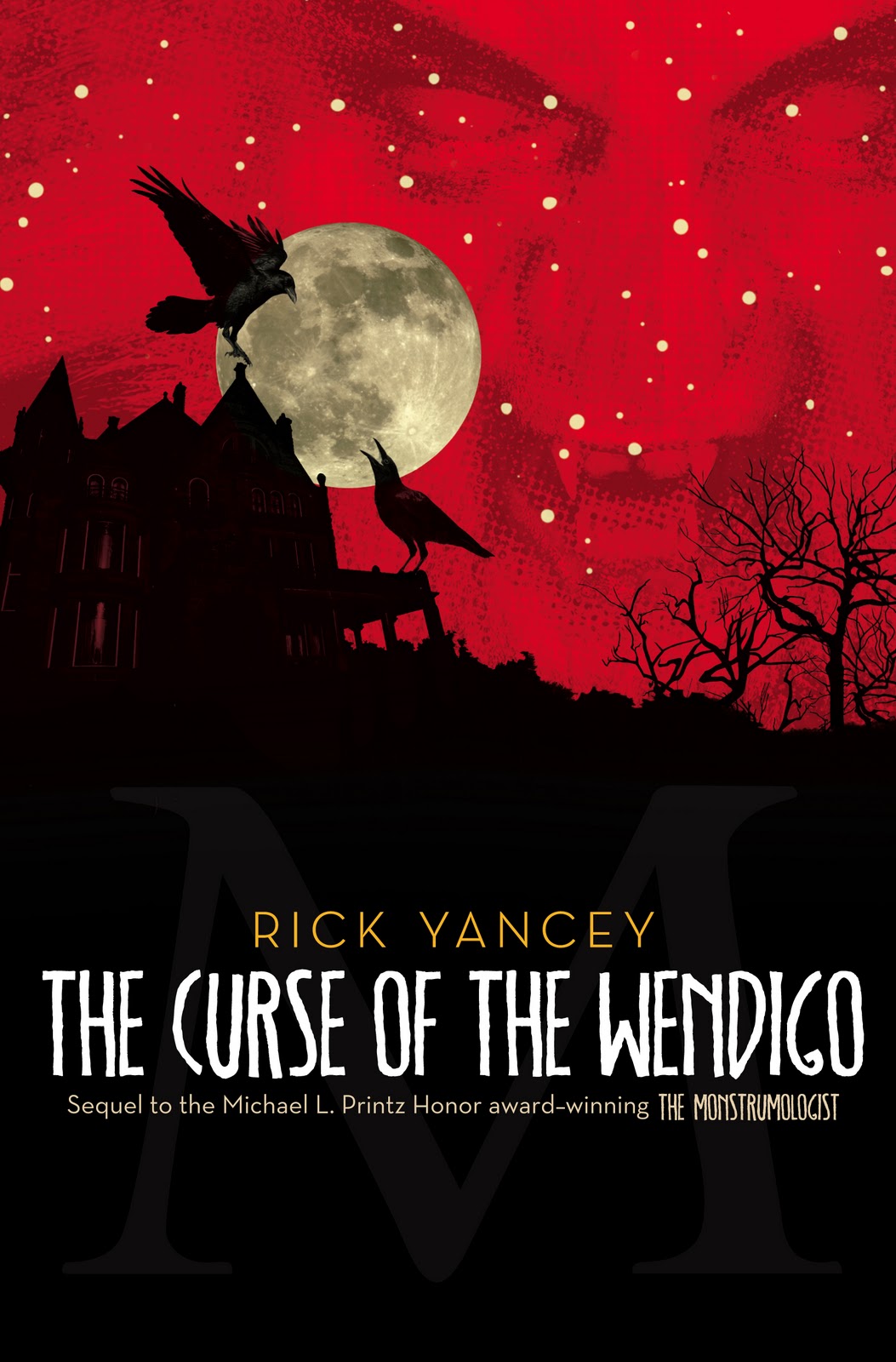
The Curse of the Wendigo - Rick Yancey


Title: The Curse of the Wendigo (Book 2 in the Monstrumologist series)
Author: Rick Yancey
Publisher: Simon & Schuster BFYR, 2010 (Hardcover)
Length: 424 pages
Genre: Young Adult; Horror
Started: February 10, 2011
Finished: February 13, 2011

Summary:
From the author's website:
While attempting to disprove that Homo vampiris, the vampire, could exist, Dr. Warthrop is asked by his former fiancee to rescue her husband from the Wendigo, a creature that starves even as it gorges itself on human flesh, which has snatched him in the Canadian wilderness.

Although Warthrop also considers the Wendigo to be fictitious, he relents and rescues her husband from death and starvation, and then sees the man transform into a Wendigo. Can the doctor and Will Henry hunt down the ultimate predator, who, like the legendary vampire, is neither living nor dead, whose hunger for human flesh is never satisfied? This second book in The Monstrumologist series explores the line between myth and reality, love and hate, genius and madness.

Review:
I loved The Monstrumologist when I read it a year ago, so of course picking up the next book in the series was a must. Surprisingly, I liked The Curse of the Wendigo even more than The Monstrumologist, something that doesn't happen that often with a sequel.

Same as in the first book, the narration is presented as the author reading the diaries of Will Henry chronicling as an adult his encounters with Dr. Warthrop as a child in 1888. The plot for this book is slightly different than in The Monstrumologist. Whereas the monsters in the first book were acknowledged by Dr. Warthrop and his colleagues, the doctor goes through this whole book protesting that he is really dealing with a Wendigo at all. When he is asked by his former lover to rescue her husband, John Chanler (Dr. Warthrop's best friend), who has been missing in the Canadian wilderness, he only agrees out of love for the both of them. Chanler had been hunting a Wendigo, a cannibalistic mythological creature from North America, and had been presumed killed. When Dr. Warthrop and Will Henry manage to find John and bring him back to civilization, the doctor believes John to be afflicted with a traumatic disorder (Wendigo psychosis) and not transforming into the monster as his colleagues believe. When John escapes to the streets of New York City and bodies begin pilling up, Dr. Warthrop is forced to reconsider that his friend might be lost to him.

I thought the concept of the Wendigo was deliciously creepy. Whereas I thought the monsters in the first book weren't very scary in description, yet the author thoroughly described the carnage they caused, they still worked in the context of a horror novel. The Wendigo on the other hand, is human in appearance and cannibalistic to boot, which made it all the more freaky, so I was definitely more creeped out while reading this novel as opposed to the first one. The relationships between characters in this novel are more fleshed out and are essentially the driving force of the book. We see Will Henry coming to terms with how he feels about staying with Dr. Warthrop and their strange father-son/master-apprentice way of dealing with each other, the weird love triangle between John, Muriel and Dr. Warthrop; plus how Dr. Warthrop interacts with his colleagues from the Monstrumological society in New York. The characters themselves are also more developed, particularly Dr. Warthrop. The writing is still superb with an extensive Victorian vocabulary as fitting of the time period.

Recommendation:
Wonderfully written horror novel that's equally creepy and better than the first book in my opinion. There are quite a lot of gruesome and graphic descriptions, not to mention some sexual stuff between the adult characters, so I wouldn't give this to the faint of heart. For those that like a good scary story, you can't go wrong here.

Thoughts on the cover:
I love the cover redesigns for these two books. The first Monstrumologist cover was okay, but I like these new ones better, even though they're very stereotypical horror and don't contain anything relevant to the actual books themselves. The cover for The Curse of the Wendigo carries on with the raven theme from the Monstrumologist cover redesign, with the two birds and an almost haunted house style backdrop with the superimposed vampire-like face in the red background. Again, nothing really relevant to the story itself, but maybe I just like the nice solid colours...that and ravens are a horror trope anyway.

Thursday, February 10, 2011

The Unidentified - Rae Mariz


Title: The Unidentified
Author: Rae Mariz
Publisher: Balzer + Bray (HarperCollins), 2010 (Hardcover)
Length: 296 pages
Genre: Young Adult; Science Fiction, Dystopian Fiction
Started: February 8, 2011
Finished: February 10, 2011

Summary:
From Goodreads.com:
Kid knows her school’s corporate sponsors not-so-secretly monitor her friendships and activities for market research. It’s all a part of the Game; the alternative education system designed to use the addictive kick from video games to encourage academic learning. Everyday, a captive audience of students ages 13-17 enter the nationwide chain store-like Game locations to play.

When a group calling themselves The Unidentified simulates a suicide to protest the power structure of their school, Kid’s investigation into their pranks attracts unwanted attention from the sponsors. As Kid finds out she doesn't have rights to her ideas, her privacy, or identity, she and her friends look for a way to revolt in a place where all acts of rebellion are just spun into the next new ad campaign.

Review:
The Unidentified is similar to Cory Doctorow's Little Brother in terms of the theme presented: massive allegory about consumerism and lack of privacy and rights in such a world. I think Little Brother pulled off the complete package better than The Unidentified, but the latter still wowed me nonetheless.

Fifteen-year-old Katey Dade (called Kid) lives in an age where education has no funding and corporate sponsors are responsible for our children's education. All students participate in the Game, and are allotted to levels based on age, Level 13-17 (aka high school as we know it) being that last section before completion. Students are equipped with "intouch" and "notebook" devices (thinly veiled references to iPhones and iPads/Macbooks) that allow them to be constantly plugged in to social networking. The corporate Sponsors look for trendsetters within the Game and "brand" them, making them the poster child for their products. Students accumulate a score based on how well they do in the educational parts of the video and virtual reality games that substitute for teachers and classrooms, which in turn can earn them prizes or scholarships that cover real-life expenses after completing the Game. Ironically, students that are branded can accumulate an impressive score by actions that result in more buzz or sales for their sponsors without even doing anything educational. I loved this premise for the novel, a look at what futuristic education might become. It's wonderfully subversive and a blatant allegory to our own modern day consumerism, especially relating to young people. In high school we always used to joke that our school was "sponsored" by Coke due to the contract they had with the school (we were just mainly mad because we couldn't buy a Pepsi on school grounds to save our life), but a scenario like in The Unidentified shows us just how close we could come to our schools turning into the Game.

The message is a necessary one, and the set-up is brilliant, but it sometimes feels a little preachy and forced, especially around the mid-point where things start to drag. Things quickly come around closer to the end where you uncover the twist and what the characters decide to do with the information they've uncovered. I think the pacing would've worked a little better if there'd been less time spent on getting to the twist and more time allotted to the aftermath, because the aftermath is more interesting than the build-up in my opinion, and that scenario really would've allowed for more character development. But the world-building and the details are definitely worth the read even if the pacing leaves a little to be desired.

Recommendation:
If you like subversive and blatant allegory with great world-building, read this! Also give this a go if you read and loved Doctorow's Little Brother.

Thoughts on the cover:
The close-up of the face is a bit too close-up for my liking, but I love the bar code at the side, I didn't even notice it right away.